

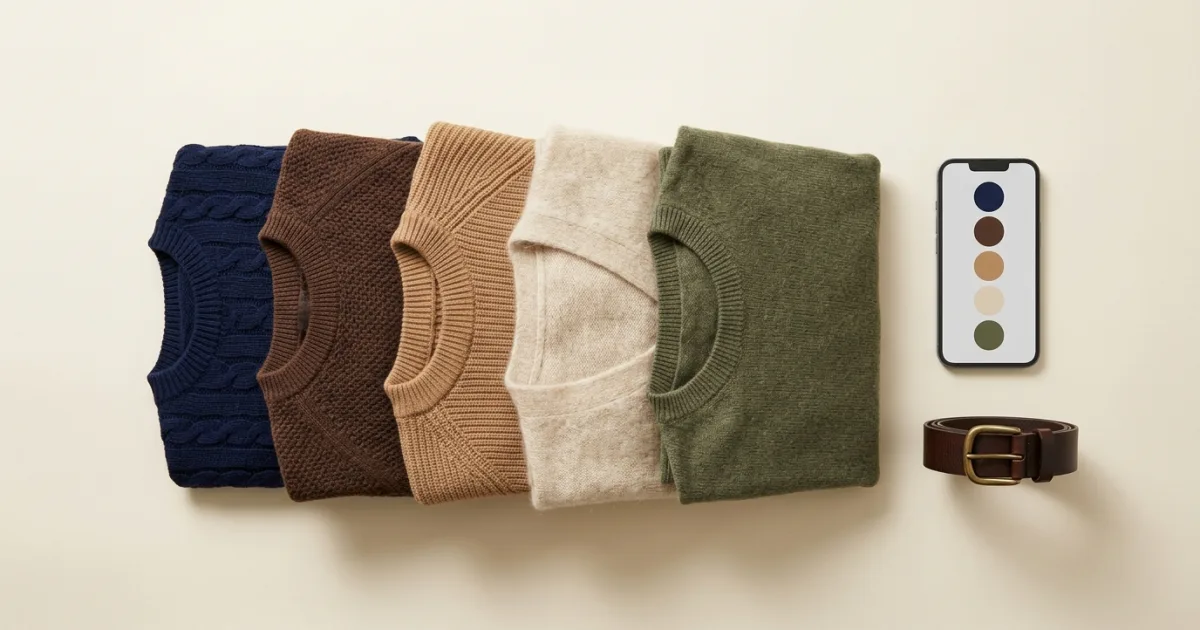
A wardrobe palette comes out of the clothes you already wear most, not out of a color theory chart.
Tops and scarves are where the palette meets your face, and that part is better judged from your coloring than from your closet. Our Wdrobe app has a color analysis that gives you a palette from a single selfie.
What a palette is for
Decide what the palette should fix: outfits that do not connect, or purchases that do not fit in. Your most-worn clothes are the starting evidence.
Work from the outfits you wear rather than the ones you admire. A palette should describe your wardrobe before it prescribes anything.
Five steps from your own clothes
1. Find the three neutrals you already repeat
The three neutrals already repeating in your most-worn outfits are your base, whether you chose them or not. Look at the last month of outfits, not at the clothes you bought with intentions. For most people it is some mix of navy, black, grey, camel, cream and denim.
2. Judge colours near the face in daylight
Hold real fabric under a window, because screens and shop lighting both lie, and shop lighting makes almost everything look good. The colours that sit next to your face, in tops, scarves and collars, matter more than the colours of trousers and shoes. If you are unsure which suit you, this guide to finding colours that suit you walks through the test.
A palette is only useful if it describes what you already own. Choosing one in the abstract is how people end up with clothes that match nothing. Start from your actual wardrobe.
3. Add one or two accents
Pick one or two accents that connect with accessories you own rather than with each other. An accent that matches nothing you own becomes the piece you never wear.
4. Test each colour against three things you own
Hold every proposed color against several garments you already have before committing to it. If it works beside three of them, it belongs in the palette.
5. Write down what works, not what is banned
Note the combinations that worked and treat the palette as a guide, not a ban. A palette that forbids things gets abandoned; one that describes what works gets used.
A worked example
Say a month of outfits shows navy trousers, a camel coat, cream knits and blue jeans on repeat. That is the base: navy and camel as the main neutrals, cream as the light one, denim as the casual one. Hold a few tops against the face in daylight and find that soft white looks better than bright white, and that a dusty rose and an olive both work. The palette is then:
- Main neutrals: navy, camel
- Light neutral: cream
- Casual neutral: mid-blue denim
- Accents: dusty rose, olive
Every top bought from now on should go with navy or camel, and any new accent has to work with cream. The lists of what colours go with navy clothes and what colours go with beige clothes help when choosing accents for a navy or a warm base, and these outfit colour combinations show how the pairs look in a full outfit. For men's wardrobes, these men's colour combinations apply the same idea to twelve outfits.
Check it against a month of outfits
After a month, see whether the palette matched what you wore. If you kept reaching outside it, the palette is wrong rather than you.
If a connecting color is missing, name where it is needed: something that bridges the navy and the brown.
If you want to see everything you own in one place, Wdrobe's digital wardrobe builds it from photos of your clothes.
Frequently asked questions
How do you build a wardrobe color palette?
Choose two neutrals as the base, one supporting neutral, and two accent colors. Everything you buy should work with at least one neutral, which is what makes a wardrobe combine without planning.
How many colors should a wardrobe have?
Around five works for most people: two dominant neutrals, one secondary neutral and two accents. Fewer becomes monotonous; more and the pieces stop combining reliably.
What are the best neutral colors for a wardrobe?
Navy, chocolate brown, cream, grey, black and camel. Taupe is a quieter choice between grey and brown, and these taupe pairings show what it goes with. Pick two that suit your coloring and stay with them, mixing every neutral is what leaves a wardrobe full of clothes that do not go together.
A palette on paper is easy. Matching it to the clothes already hanging up is the part that takes an evening. Put your clothes side by side on screen and see which palette you are already halfway to.